Specification Management

Build a connected product model that people and AI can safely change.

Reqode keeps requirements, user interfaces, data entities and API behavior in one structured source of truth. Stable identities, explicit relationships, controlled revisions and branch-aware context help teams and AI agents work from the same product intent.

Get Early Access
Get Early Access

Specifications should guide delivery

Traditional documentation captures separate fragments of product knowledge. Requirements live in documents, API behavior in another tool, interface decisions in design files and implementation context in tickets or AI conversations.

Reqode models product behavior as focused, typed and connected artifacts, so teams can understand what is true now, how it changed, what depends on it and which context should guide delivery.

DISCONNECTED DOCUMENTATION

Product knowledge must be reconstructed for every change

  • Behavior, data, UI and API decisions live in separate formats.
  • Dependencies are rediscovered during implementation and review.
  • AI conversations can become accidental product truth.
  • Historical intent is difficult to recover after the product changes.
REQODE PRODUCT MODEL

One connected context follows the product

  • Typed artifacts preserve focused product knowledge.
  • Explicit relationships make dependencies navigable.
  • Branches and revisions preserve controlled change context.
  • People and AI work from the same reviewed source of truth.

One connected model for product behavior

Reqode separates product knowledge into artifacts that remain understandable on their own and useful together.

Requirements

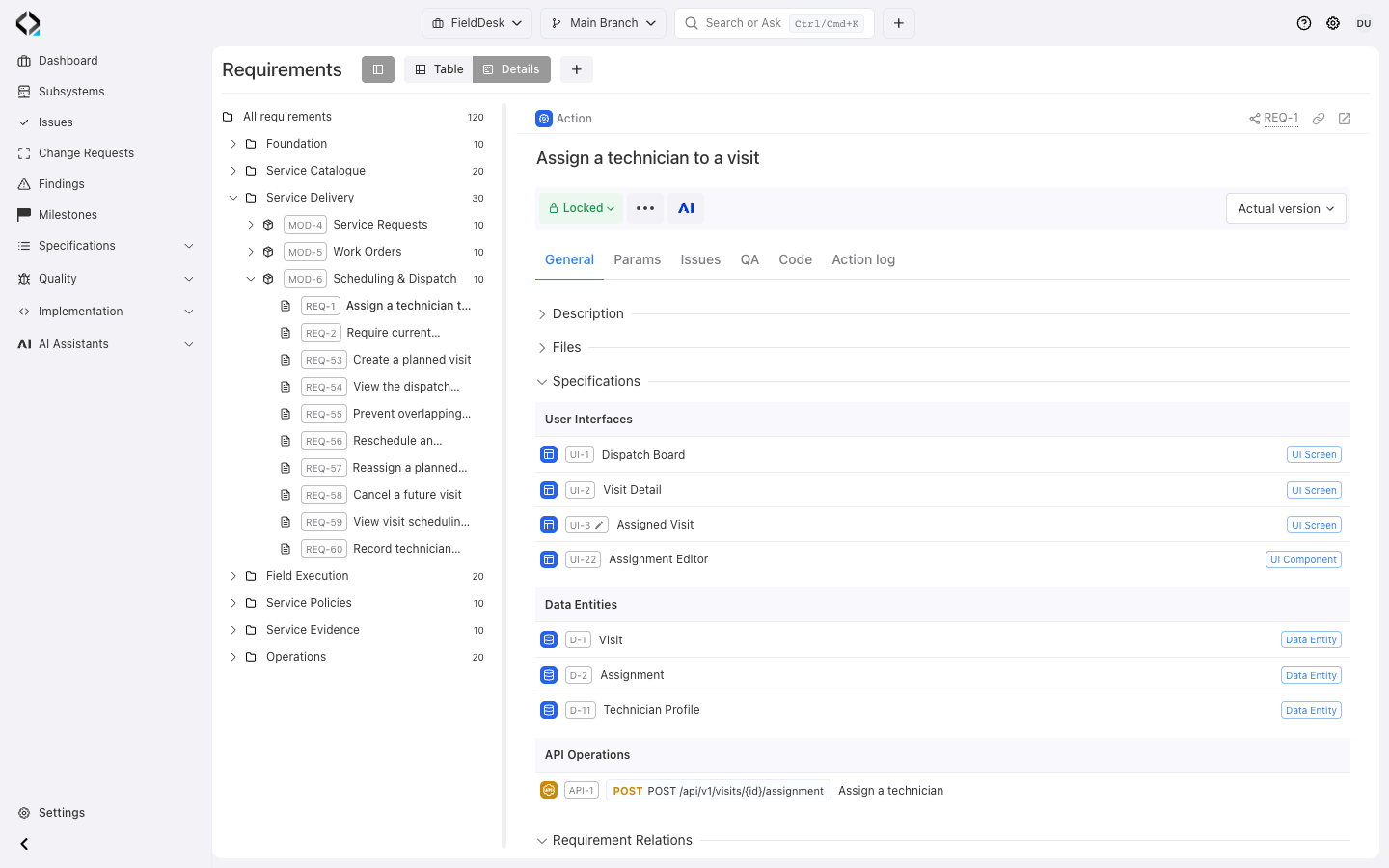
Describe product behavior and use cases through typed requirements organized into folders and modules.

User Interfaces

Capture screens, navigation relationships and wireframes connected to the behavior they support.

Data Entities

Define reusable business data, attributes, values and relationships referenced across specifications.

API Operations

Describe system interfaces and operations in the context of the requirements they implement.
STRUCTURED REQUIREMENTS

Organize requirements around the product, not around documents

Requirements are organized into folders and modules that reflect the logical structure of the product. Teams can search, filter, group and sort the repository without losing the surrounding context.

A requirement can describe one focused behavior while remaining connected to related requirements, subsystems, actors and supporting UI, data and API specifications.

This gives people and AI a bounded starting point instead of an unstructured documentation dump.

PROJECT BRANCH · FEATURE-AUTH
Effective specification context
Authentication module
REQ-42 · Enterprise authentication
Forked in branch REV. 3
REQ-51 · Password recovery
Inherited REV. 2
REQ-68 · SSO provider selection
Created in branch REV. 1
CONTROLLED CHANGE

Work in a branch-aware specification context

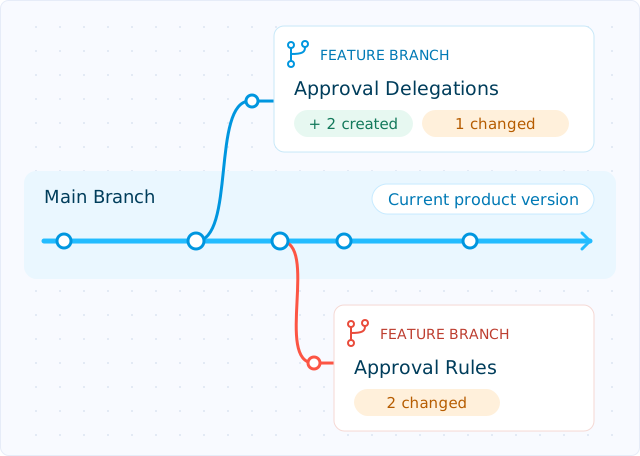
Reqode project branches provide an isolated specification context for feature work, corrections and larger product changes.

Inherited artifacts remain connected to Main Branch until they are changed. Branch-local versions preserve the same stable identity while making their state explicit: inherited, forked, created or deleted in the branch.

Teams and AI work with the effective state of the selected branch without copying the entire repository or losing historical context.

CONNECTED SPECIFICATIONS

Make product relationships explicit

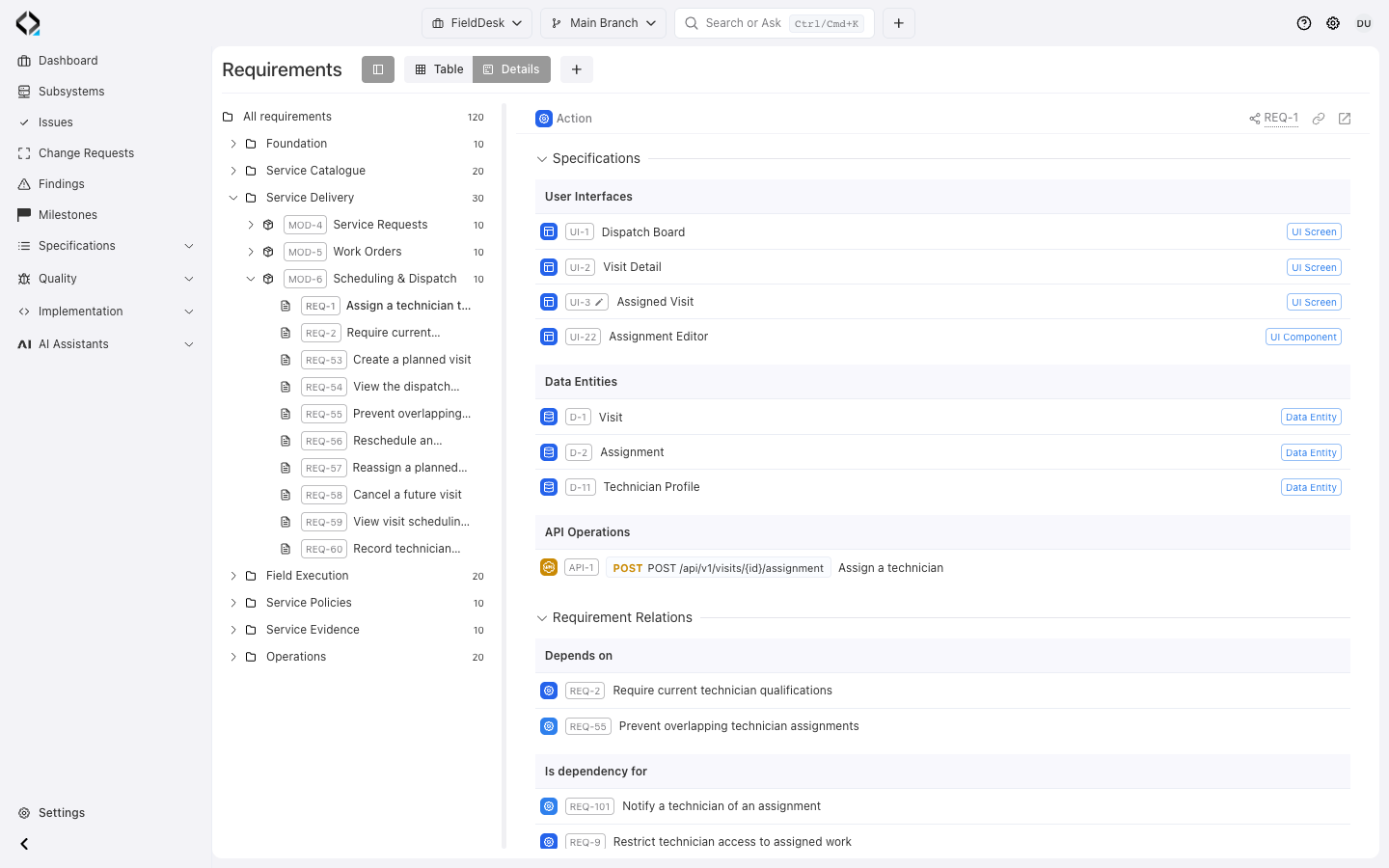
A requirement rarely stands alone. Teams can connect existing specifications or create new User Interfaces, Data Entities and API Operations in the same working context.

Requirement-to-requirement relations capture behavioral dependencies. Specification-to-unit relations connect product intent with implementation structure. Change Requests preserve the exact specification revisions affected by a change.

The result is a navigable product model rather than a collection of isolated documents.

REQ-42 · ENTERPRISE AUTHENTICATION

Connected context

UI-18 · Sign-in screen
User Interface
D-24 · Identity provider
Data Entity
API-27 · Start SSO session
API Operation
U-214 · AuthenticationService
Software Unit

See the model from the angle the task requires

Move between structured tables and visual views without separating the diagram from the underlying product context.

Traceability Table
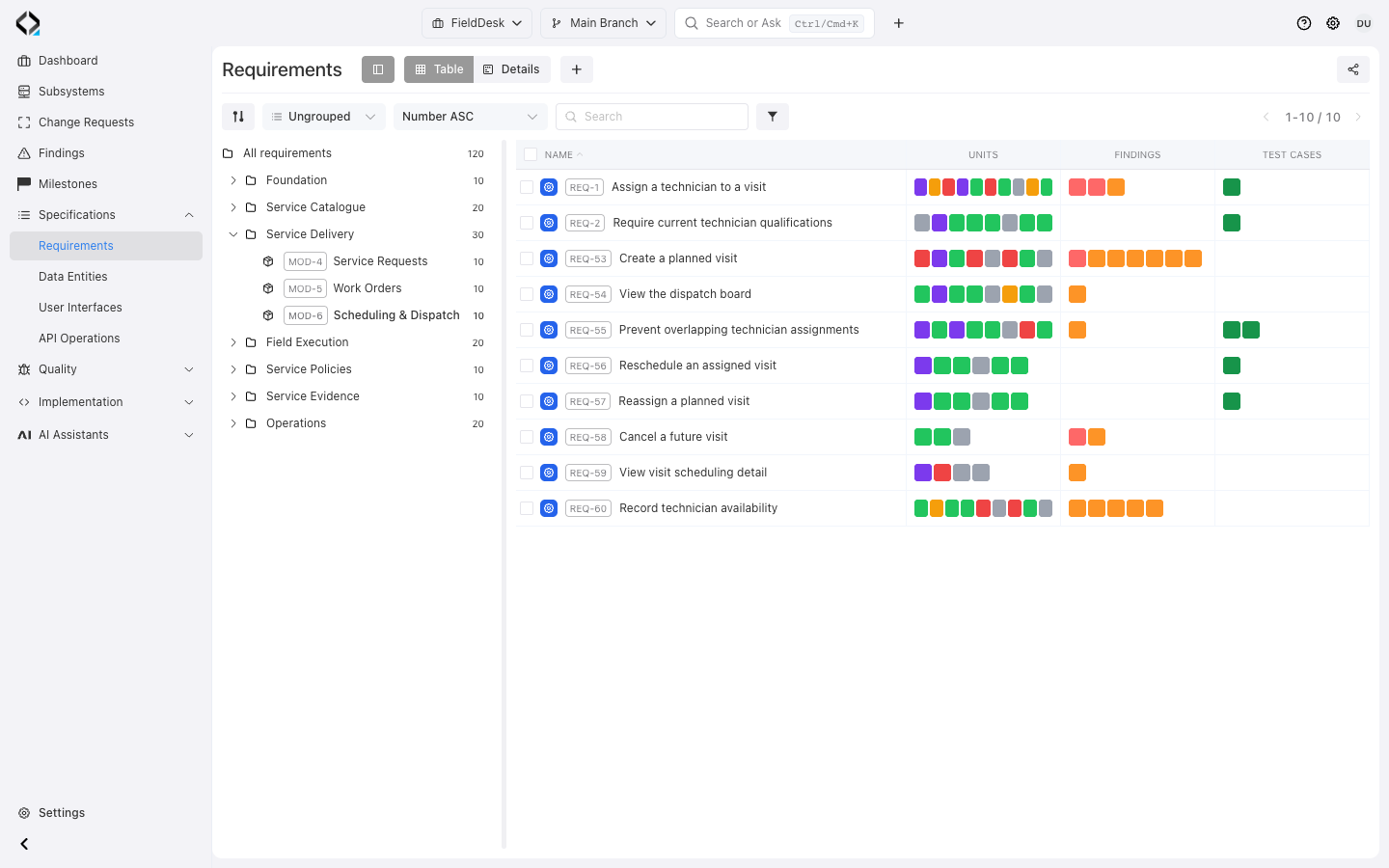
Review how requirements connect to related specifications, software units, change context and verification evidence.

Specification Relationship Graph

Explore dependencies between requirements, data entities, user interfaces, APIs and other connected artifacts.

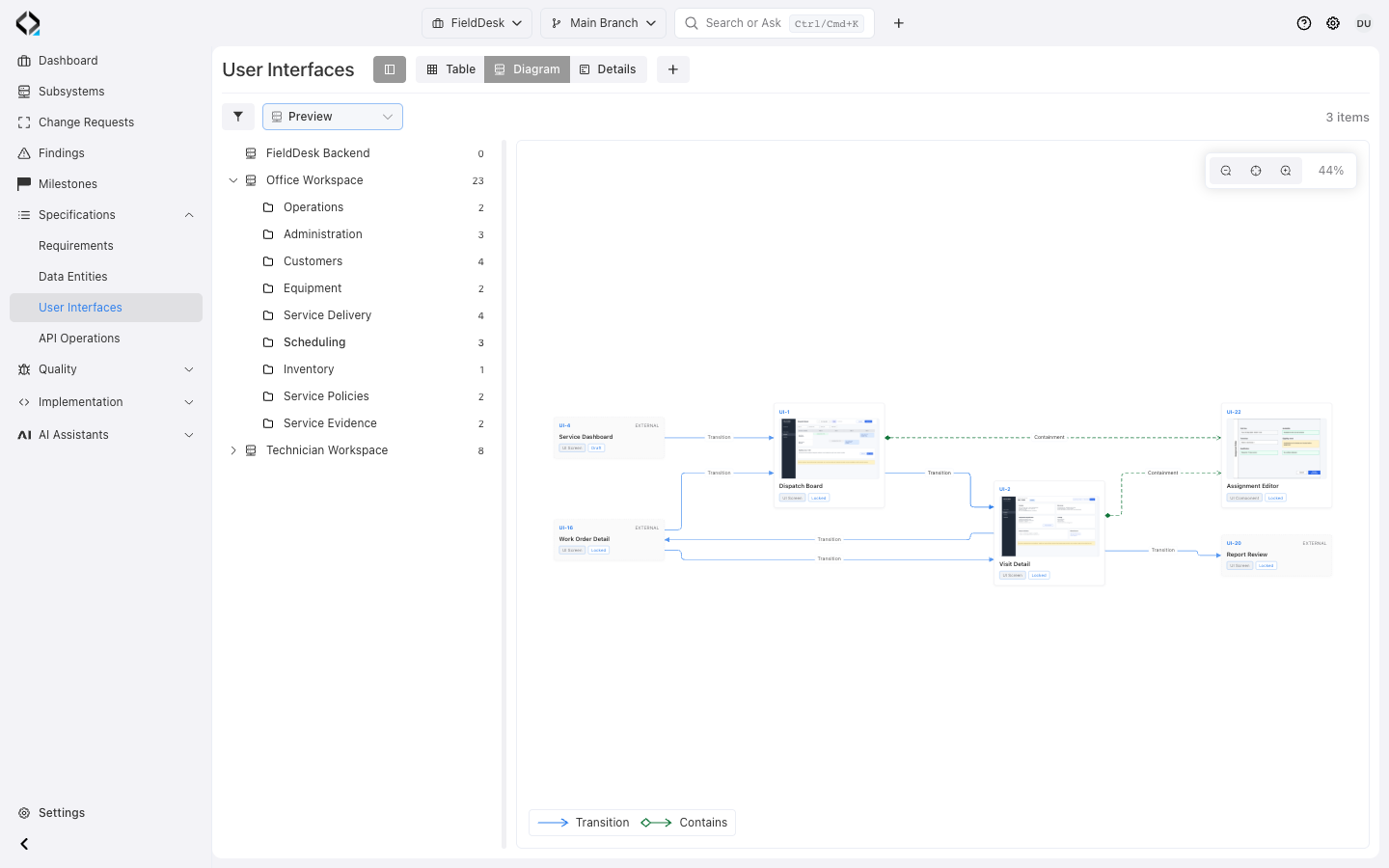
User Interfaces Diagram

Understand navigation and containment across product screens, with compact and wireframe-preview display modes.

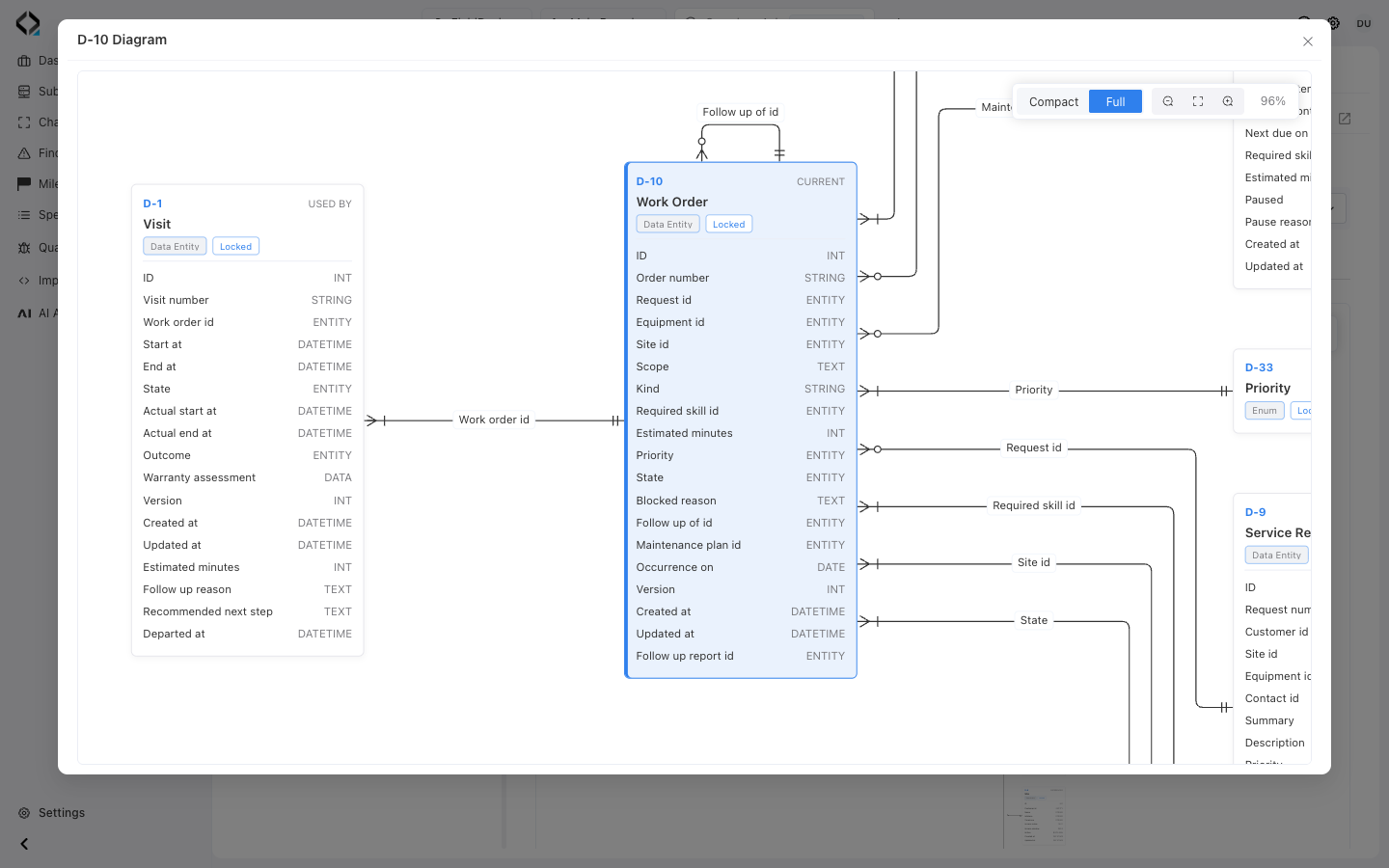
Entity Relationship Diagram

Inspect the structure and relationships of Data Entities within the selected project and branch context.
SPECIFICATION HISTORY

Preserve what was true at every stage

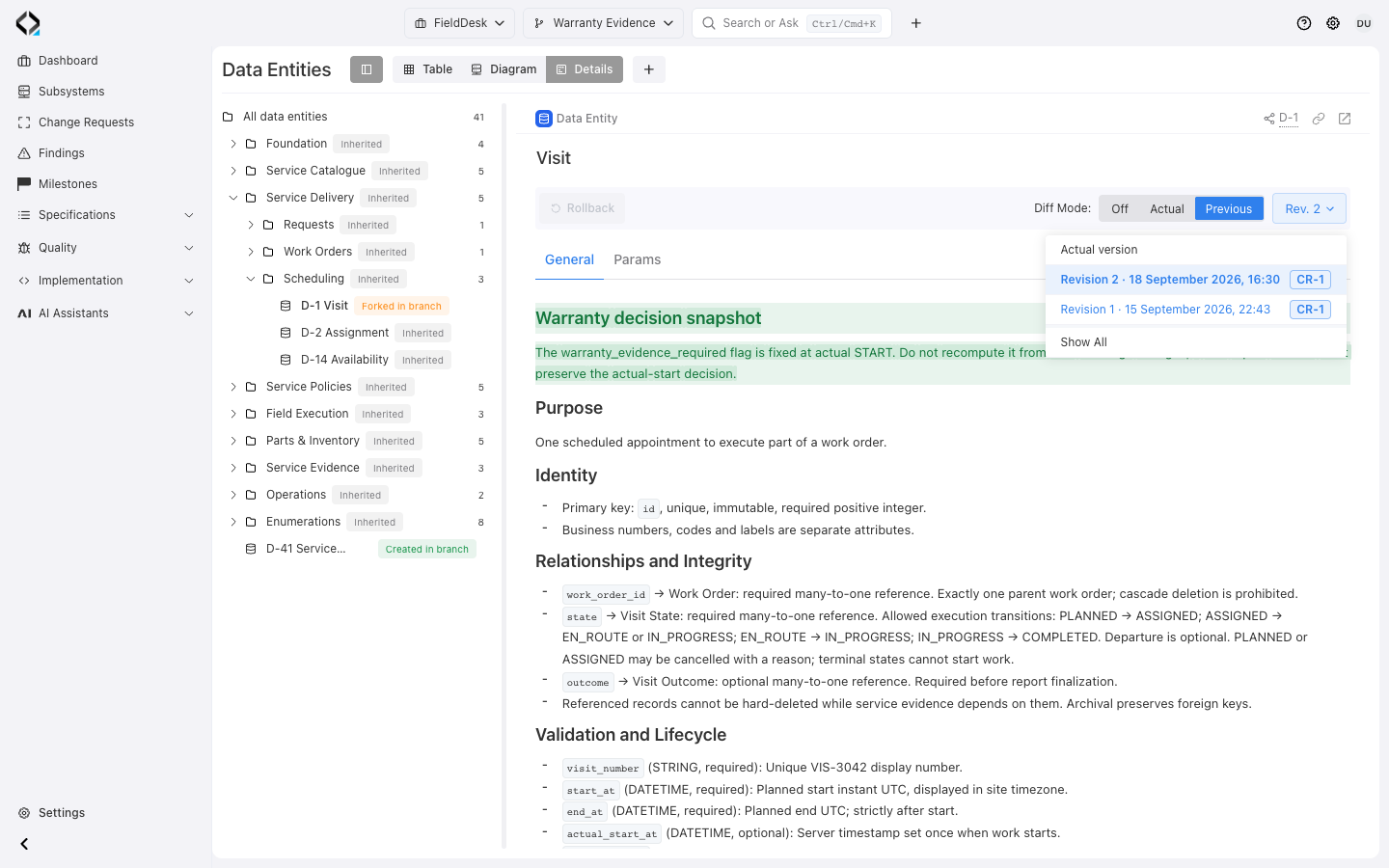
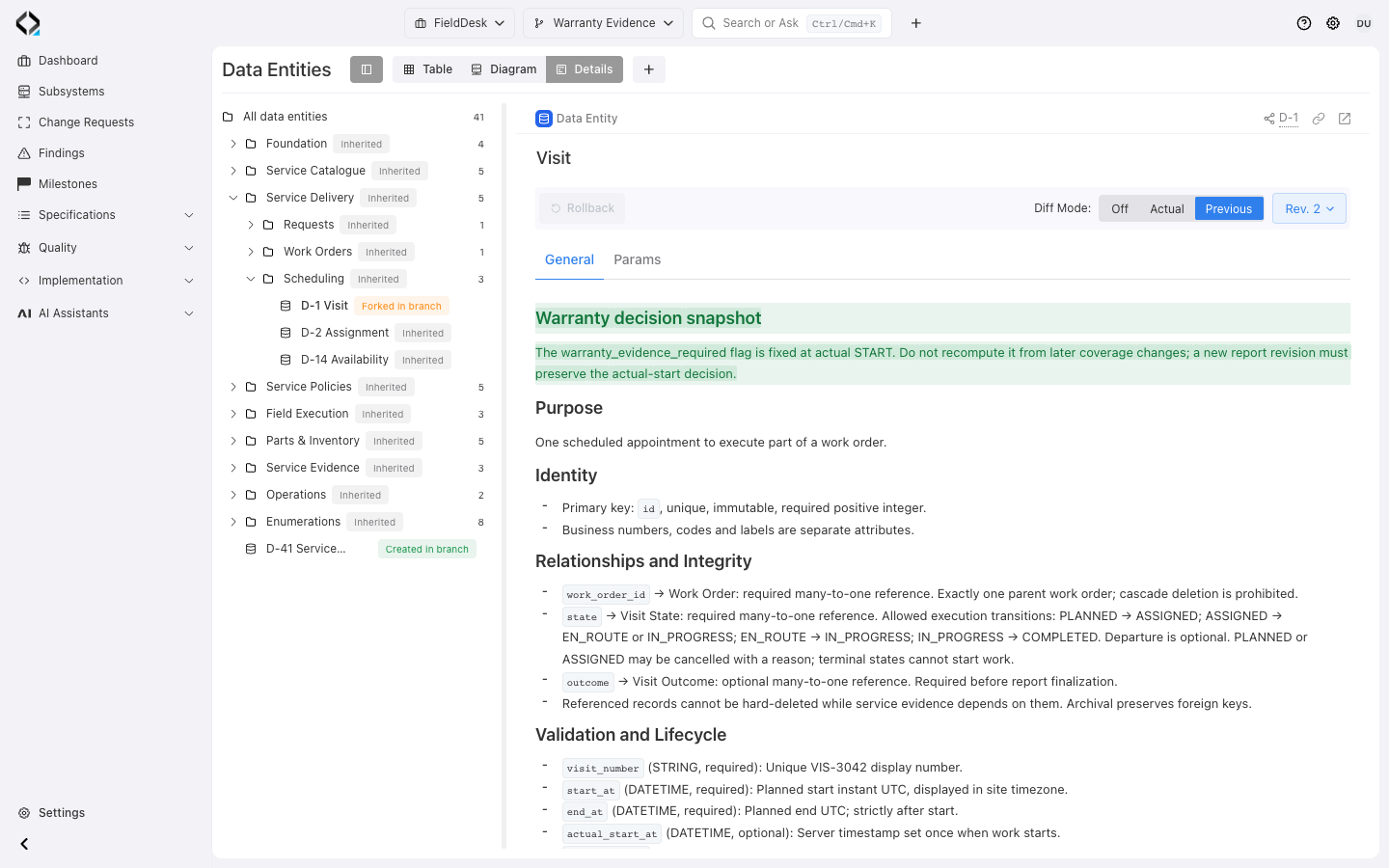
Reqode separates the current version of an artifact from its historical revisions without changing its stable product identity.

Teams can lock an accepted version, create a new revision when behavior must change, inspect historical states, compare changes and roll back when necessary.

Change Requests can reference the exact revisions involved in a product change, preserving both the current source of truth and the context that led to it.

Explore Change Management

REVIEWABLE AI ASSISTANCE

AI can prepare the change without becoming the source of truth

Reqode AI Analyst works with selected product context and prepares structured specification changes for review. Specifications change only after an explicit Apply action.

1

Start from real context

Begin with requirements, modules, Findings, Issues, Change Requests or implementation discoveries.
2

Clarify what is missing

AI Analyst asks focused questions when expected behavior or constraints are underspecified.
3

Prepare structured changes

The result can include Requirements, Data Entities, User Interfaces, wireframes and API Operations.
4

Review before Apply

The team reviews and edits the structured result before it changes the product model.

From product question to reviewable specification change

AI Analyst uses the current project and branch context, keeps proposed changes separate from accepted product truth and preserves a clear user-controlled Apply step.

Explore the AI Analyst workflow

Keep specifications useful after implementation starts

Apply consistent authoring guidance, verify focused product context and preserve confirmed problems as evidence connected to the affected artifacts.

Templates and AI guidance

Define templates and AI guidance for each artifact type so people and assistants use the same expected structure.

Findings with evidence

Preserve confirmed inconsistencies and drift as Findings with severity, evidence, affected artifacts and possible resolution paths.

Specifications ↔ implementation alignment

Connect specifications to Software Units and verify whether implementation remains aligned with the behavior those specifications describe.

See Specification Management in context

Walk through how requirements, related specifications, revisions and implementation context work together inside Reqode.

Third-party content loads only after your click.

Turn specifications into working product context

Give product teams, engineers and AI agents one connected view of behavior, change history and implementation scope.

Get Early Access
Get Early Access