Less prompting. More control.
Built for software developers using Codex, Cursor, and Claude Code.
The Challenges of AI Coding

Too Many Handoffs
You spend a lot of time briefing agents, coordinating tasks, and stitching results together. Each step needs another prompt, another handoff, and more of your attention.

Lost Product Context
Product decisions get scattered across chats, documents, and code. AI agents and team members repeatedly reconstruct the same context, losing key details and connections.

Architecture Drift
Local changes drift from architectural rules, component responsibilities, and subsystem boundaries that the agent cannot see.
How Reqode Solves It
Reqode gives teams a connected, branch-aware product and implementation model, exposes focused context to AI agents, and verifies work against that source of truth. Use the model to guide the next feature, then use verification and reviewed changes to keep it current.
- Product model Requirements, APIs, data, UI, architecture, linked code
- Feature specifications Reviewed changes with connected context
- Agent implementation A defined change guided by the model
- Verification & reviewed updates Check the result and resolve differences
- Product model Updated context for the next change
Capabilities
 Specification Management
 Change Management
 Architecture & Software
Units Blueprints
Architecture & Software
Units Blueprints
 AI
Assistants
MCP for
AI Coding Agents
AI
Assistants
MCP for
AI Coding Agents
 MCP for AI QA Agents
Built for products with more moving parts
Reqode is designed for projects where a single feature touches connected data, APIs, interfaces, and business rules across your system.
-
Prototype
One repository
A few data entities
One main user flow -
Focused product
One app and its backend
Dozens of data tables
Several user roles -
Connected product
Multiple apps or services
Shared data and API contracts
Roles and cross-app workflows -
Complex system
Multiple repositories
Hundreds of data tables
Many roles and integrations
- Prompt engineering: prototypes through focused products.
- Open-source spec frameworks: focused products into complex systems, overlapping with prompts and Reqode.
- ReqodeConnected context across the system: from focused products through complex systems.
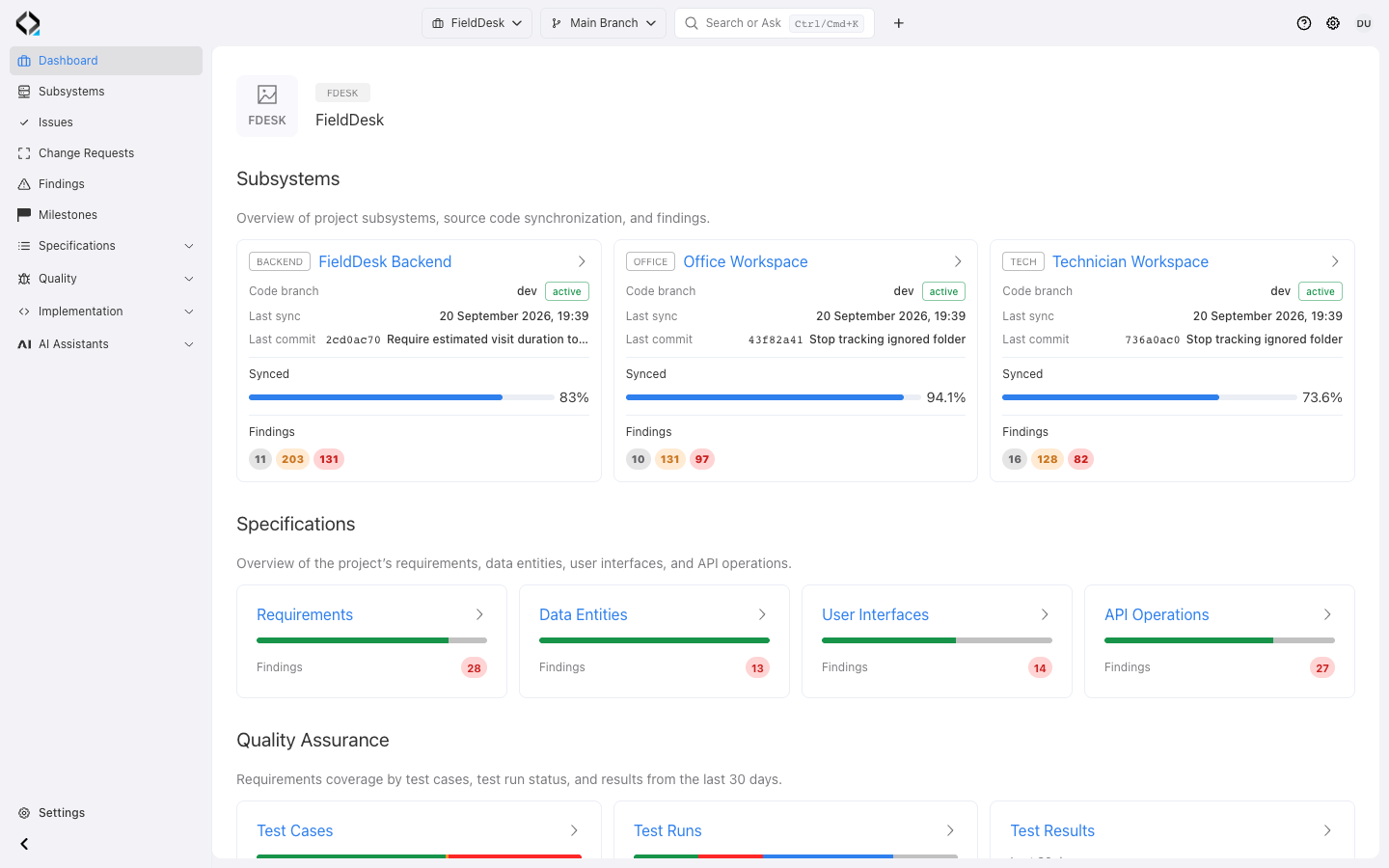
Explore your product specifications
Start from FieldDesk’s dashboard and explore Requirements, Data Entities, User Interfaces, or API Operations.
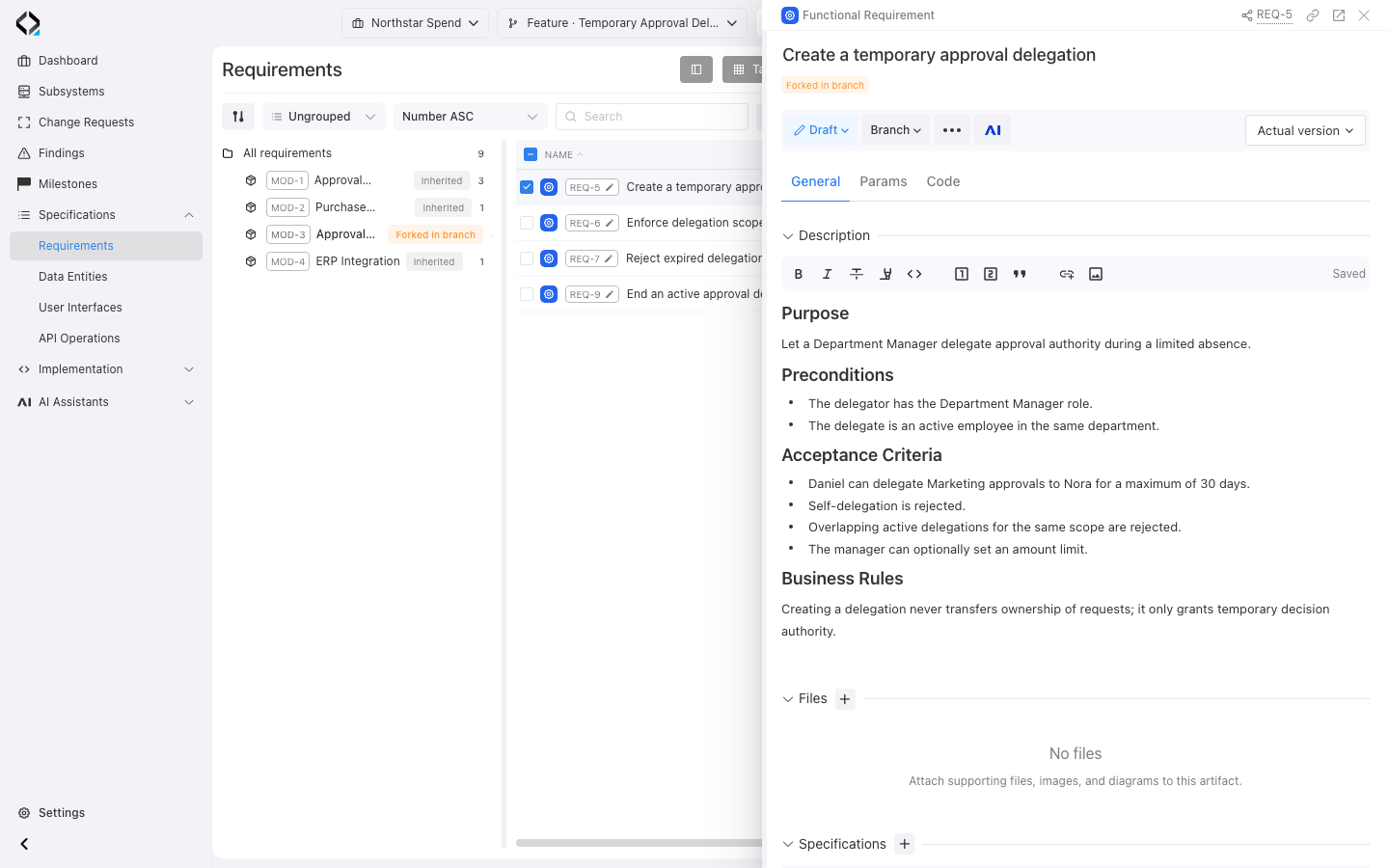
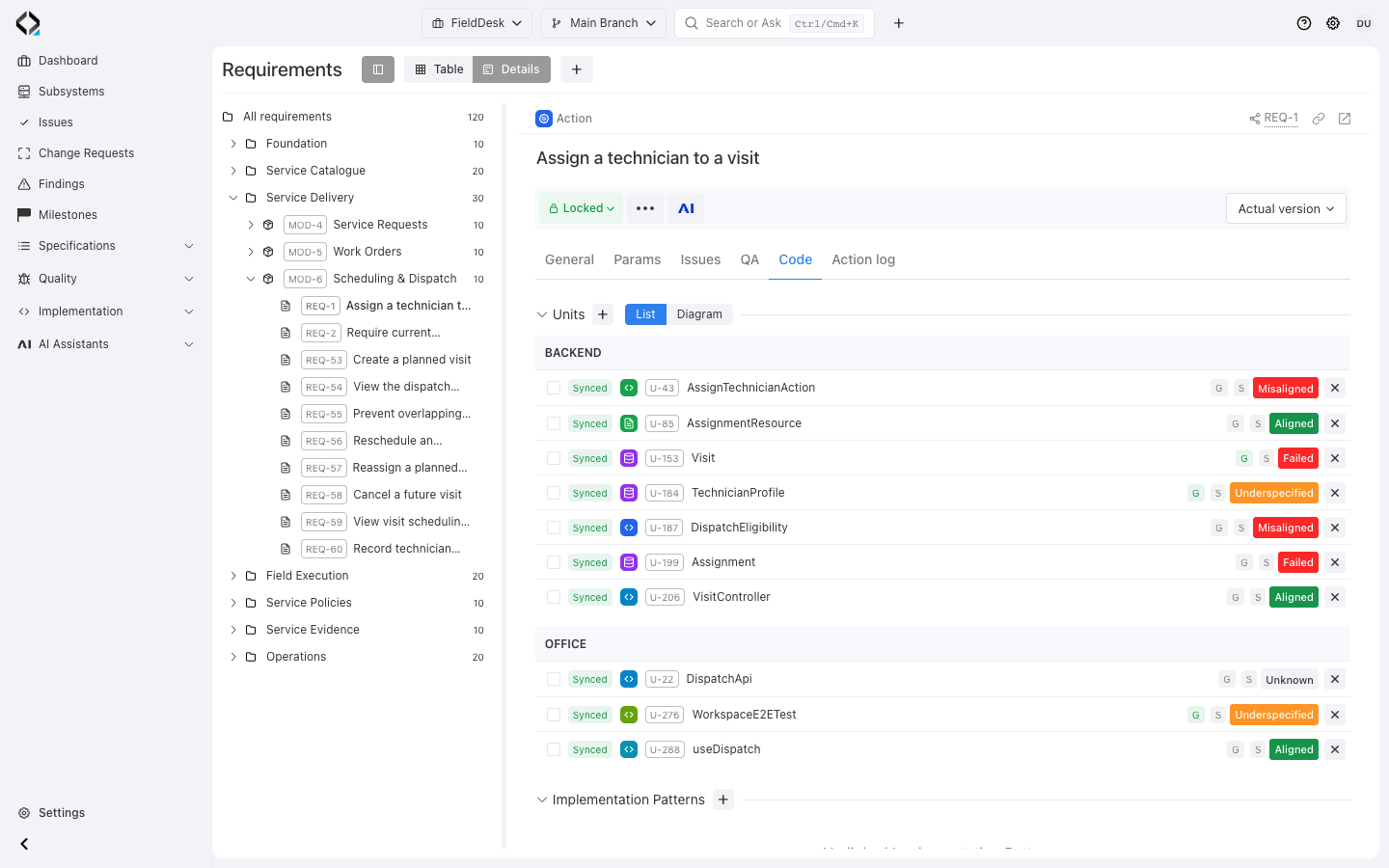
Your product model is your AI’s memory.
Reqode turns product knowledge into structured, verified context that persists across tasks, agents, and code changes.
- Reqode Requirements, specifications, architecture, and change history MCP
- AI coding agents Focused, branch-aware context for each task
- Source code repository Implementation connected to your product model

Where to Start
Frequently Asked Questions

Use an MCP-compatible agent such as Codex, Cursor, or Claude Code. Reqode supplies product and implementation context while the agent works in your coding environment. See MCP for Coding Agents.
Yes. Start with one relevant area, connect its repository context, and review the specifications that describe it. You can expand the model as you make further changes.
Your team can write them directly or use AI Analyst to clarify a feature and propose changes. Review the proposed diff and apply the accepted result.
Your team chooses the intended behavior, accepts specification changes, reviews the implementation and evidence, and decides what to release.
AI verifiers inspect specifications, architecture guidance, and linked implementation within their defined scope. Test runs record execution results.
Reqode connects implementation with subsystem architecture rules, unit guidelines, and component responsibilities. AI verifiers check the selected code against that guidance and record findings for your team to review. Explore architecture checks.
Review the intended behavior before choosing a correction. If the product decision has changed, your team can use AI assistance to prepare a specification update, review and apply it, then check the implementation against the revised specification. Explore how to resolve a mismatch.