Contact Us

Contact us if you have any questions, suggestions or you need personal Demo of Reqode. Use the form or write us a letter.

Existing Software Flow
Bring an existing codebase under Reqode control: map repositories into subsystems, derive architecture rules, discover software units, recover current product specifications, and continue development with AI agents that work from verified context.
Get Early Access
Get Early Access

The Adoption Flow

Reqode does not require a rewrite. The team creates a product model around the software that already exists, validates it once, and then uses it as the source of truth for future AI-assisted development.

1

Connect the product structure

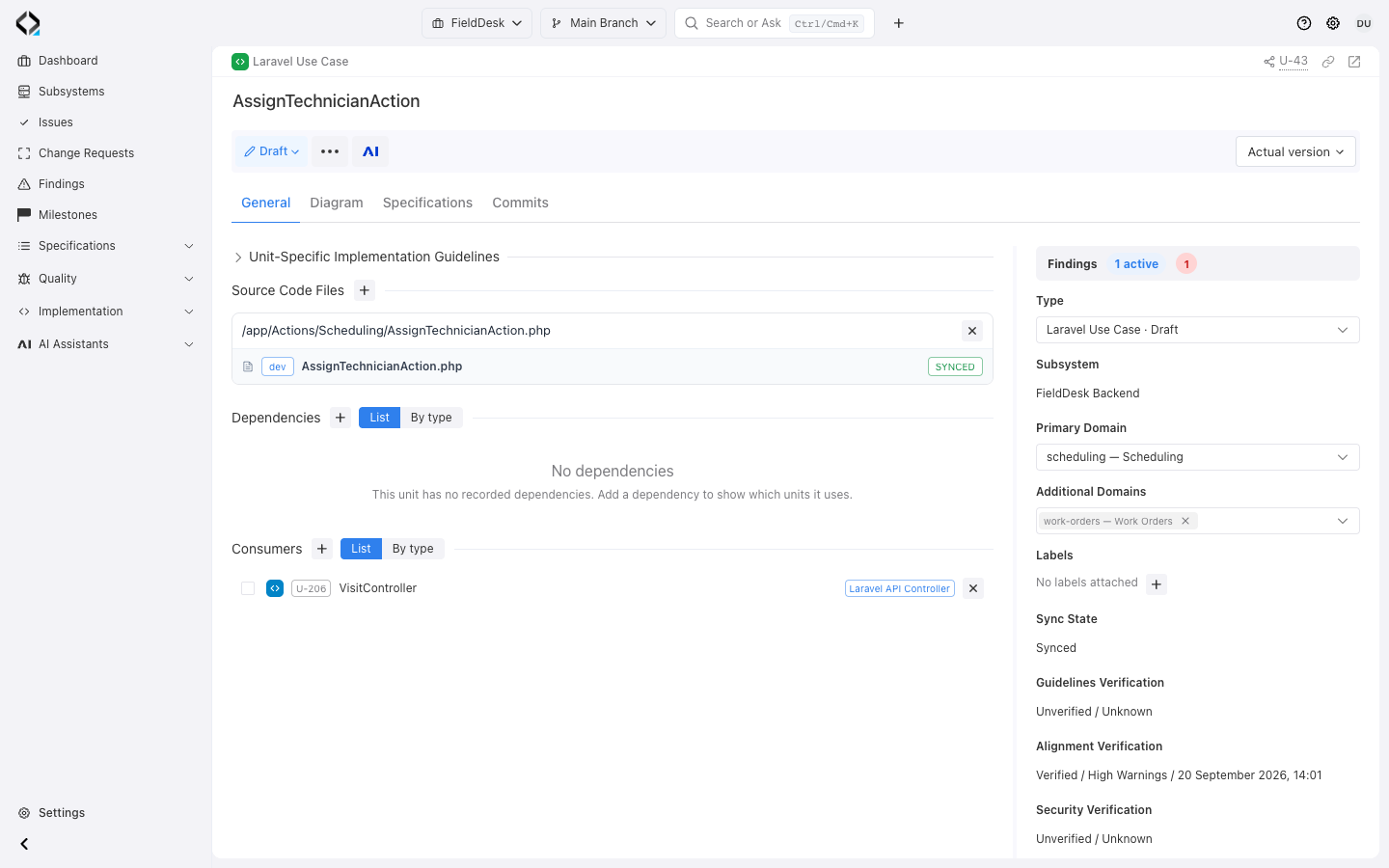
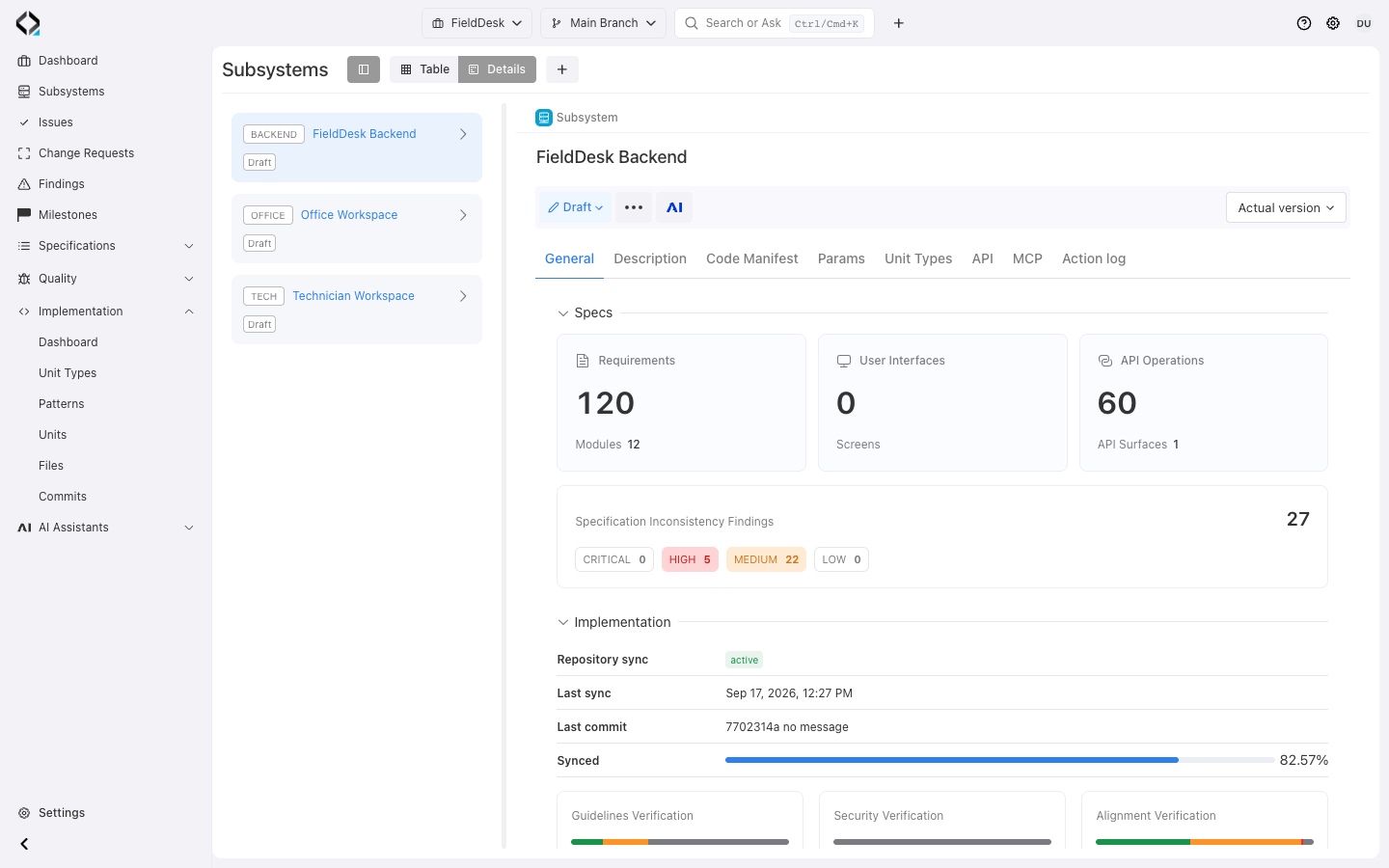
Add subsystems for the main technical parts of the product, then connect repositories and branch mappings for each one.

Backend API, frontend app, mobile app, worker, admin panel, SDK, or integration service.
For a monolith, start with one subsystem and split later when the model proves it.
2

Derive architecture guidance

Use AI Architect to prepare the Code Manifest, Unit Types, allowed spec relations, and subsystem-wide implementation rules.

The result is reviewable before it becomes the architecture contract.
Legacy patterns can be documented, deprecated, or isolated.
3

Run AI Unit Discovery Agent

Analyze selected implementation files to create Software Units, assign files, detect dependencies, and preserve key relations.

Run it by subsystem, folder, repository area, existing unit, or files that will change soon.
Ignored files, new Unit Types, and missing dependencies stay visible for review.
4

Capture implementation patterns

Document recurring approaches such as approval flows, tenant-aware APIs, import pipelines, background jobs, and UI list-detail patterns.

Patterns give humans and agents reusable guidance between business requirements and concrete units.
5

Recover current product specs

Use AI Analyst to turn current source code and behavior into requirements, data entities, UI behavior, API operations, and traceable links to units.

The target is not static documentation. It is a product map that can guide the next change.
6

Develop through Reqode

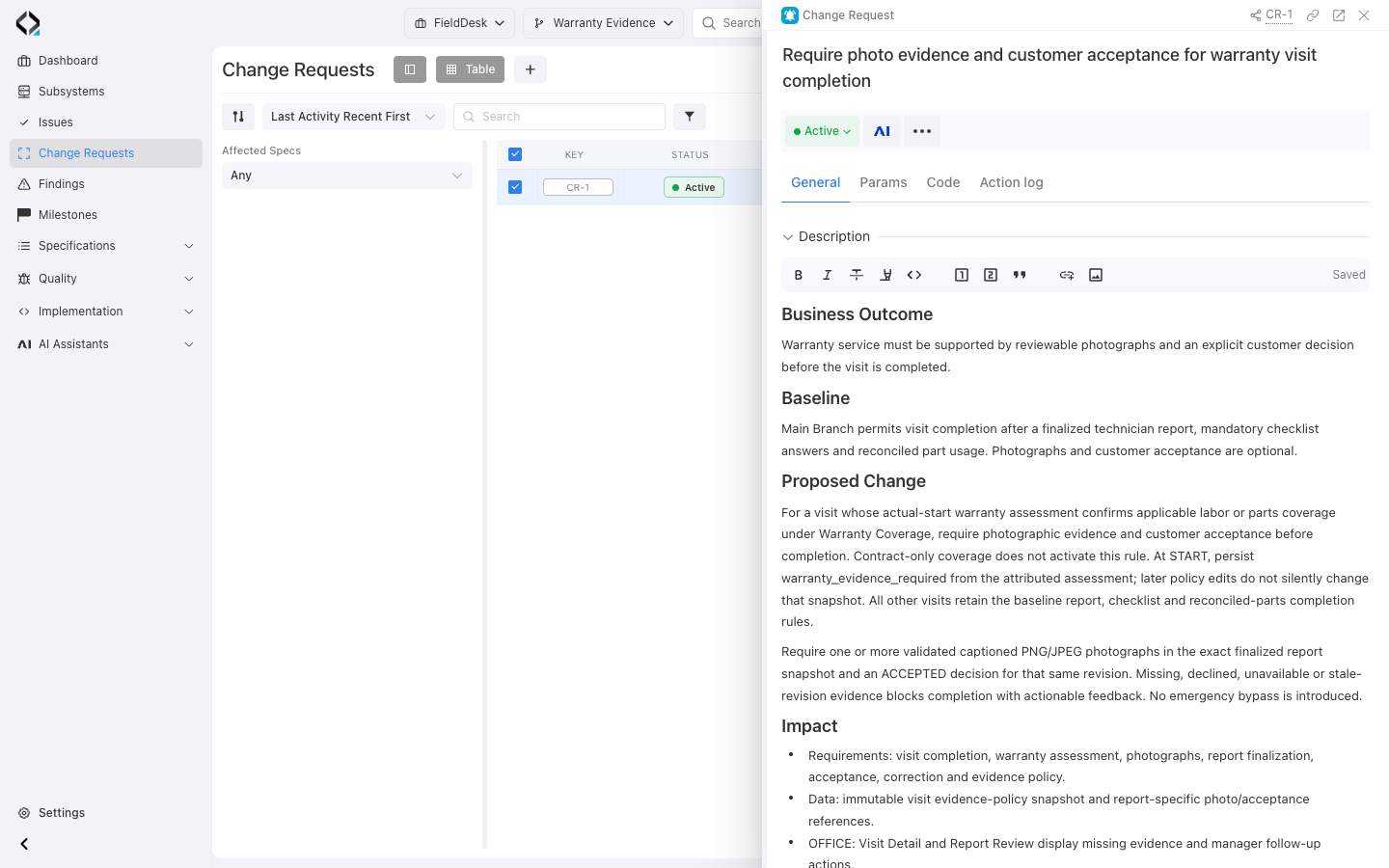
Start future work from a Change Request, update specifications first, hand the CR-* key to a coding agent through MCP, then verify the result.

Reqode checks spec-code alignment, guidelines, and architecture drift after changes land.

What Reqode Builds Around Existing Software

Most existing products already contain the truth, but it is spread across source code, tickets, pull requests, old documents, and team memory. Reqode turns that truth into connected artifacts that both people and AI agents can query.

Higher-level than code: product intent, architecture rules, unit ownership, dependencies, specification links, and change reasons become explicit. Code remains the implementation, but it is no longer the only source of product truth.

The Core Assets After Onboarding

The one-time adoption work creates operational assets that continue to matter during every future change.

Code Manifest

Subsystem-wide guidance for coding style, structure, integration points, testing expectations, architecture constraints, and AI agent instructions.

Unit Types

Architecture roles such as controller, service, query, model, component, job, integration client, API operation, or test, each with its own implementation guidance.

Software Units

Logical implementation areas connected to files, folders, dependencies, consumers, guidelines, specifications, verification state, and Findings.

Product Specs

Requirements, data entities, user interfaces, wireframes, API operations, implementation patterns, and traceability links recovered from the current product.

The Ongoing Change Loop

Once the current product is represented in Reqode, new work moves through a controlled loop. Changes are introduced through specifications with the help of the Reqode AI Analyst agent. AI coding agents then receive focused, traceable product and architecture context through MCP, while Reqode keeps verification visible.

1. Ask the Reqode AI Analyst agent to turn a high-level description of desired changes into reviewable specification updates.
2. Reqode shows the affected specifications and highlights what is changing, so you can review the specific proposed changes instead of going through a large set of full specs.
3. Wrap the AI Analyst’s proposed edits into a Change Request, which becomes the execution context for the AI coding agent, including specification changes, traceability to code, impacted areas, and relevant architecture constraints.
4. Give the coding agent a stable change request CR-* key through MCP.
5. After implementation, Reqode verifies code–spec alignment and compliance with architecture guidelines.

Good Starting Points

Existing products do not need to be modeled all at once. Reqode can start with the areas where alignment matters most.

Single monolith

Create one subsystem, derive the initial architecture manifest, then run Unit Discovery folder by folder.

Multi-repository product

Model each deployment boundary as a subsystem, connect repositories, and make cross-subsystem dependencies explicit.

Critical flow first

Start with billing, onboarding, checkout, approvals, or any area where business risk is high and code knowledge is fragile.

Finding-driven cleanup

Use verification results to decide whether code, specs, units, or architecture guidance need to be corrected.

Before and After Reqode

The value is not only documentation. The value is making AI-assisted development controllable after the first onboarding pass.

Before

Product behavior is inferred from code, tickets, and team memory.
Architecture rules live in conventions that are hard for agents to follow.
AI coding prompts repeat context manually and miss branch-specific product decisions.
Documentation goes stale because it is separate from change work.

After

Subsystems, units, specs and test cases are explicit and searchable.
AI agents receive Code Manifest, Unit Types, relevant files, and focused and traceable product context.
Spec-code alignment, architecture drift, and findings stay visible.
Reqode becomes the higher-level source of truth for the next product decision.

Ready to Bring an Existing Product into Reqode?

Start with one subsystem, one repository area, or one critical product flow. Reqode can build the first trusted map around the code you already have.

Get Early Access
Get Early Access