Contact Us

Contact us if you have any questions, suggestions or you need personal Demo of Reqode. Use the form or write us a letter.

New Software Flow

Go from product idea to implementation-ready software: shape the product model, create reviewable specifications with AI Analyst, define subsystem architecture, hand exact context to coding agents through MCP, and verify that new code stays aligned with intent.
Get Early Access
Get Early Access

The New Software Flow

Reqode creates the source of truth before the first serious implementation pass. The product model, architecture rules, coding context, units, tests, and verification signals stay connected as the system grows.

1

Add subsystems

Model the future technical boundaries: backend, frontend, mobile app, worker, integration service, admin panel, or shared package.

Connect repositories when they exist.
Use presets when the stack or subsystem set is already known.
2

Define the architecture contract

Use AI Architect to prepare Code Manifest and Unit Types for each subsystem before the coding agent starts shaping the repository.

Document naming, folder structure, execution flow, testing expectations, and allowed spec relations.
3

Create the product model

Use AI Analyst to turn high-level product ideas into requirements, data entities, user interfaces, and API contracts.

AI output remains reviewable until Apply.
The team edits or disables speculative items before they become product truth.
5

Implement

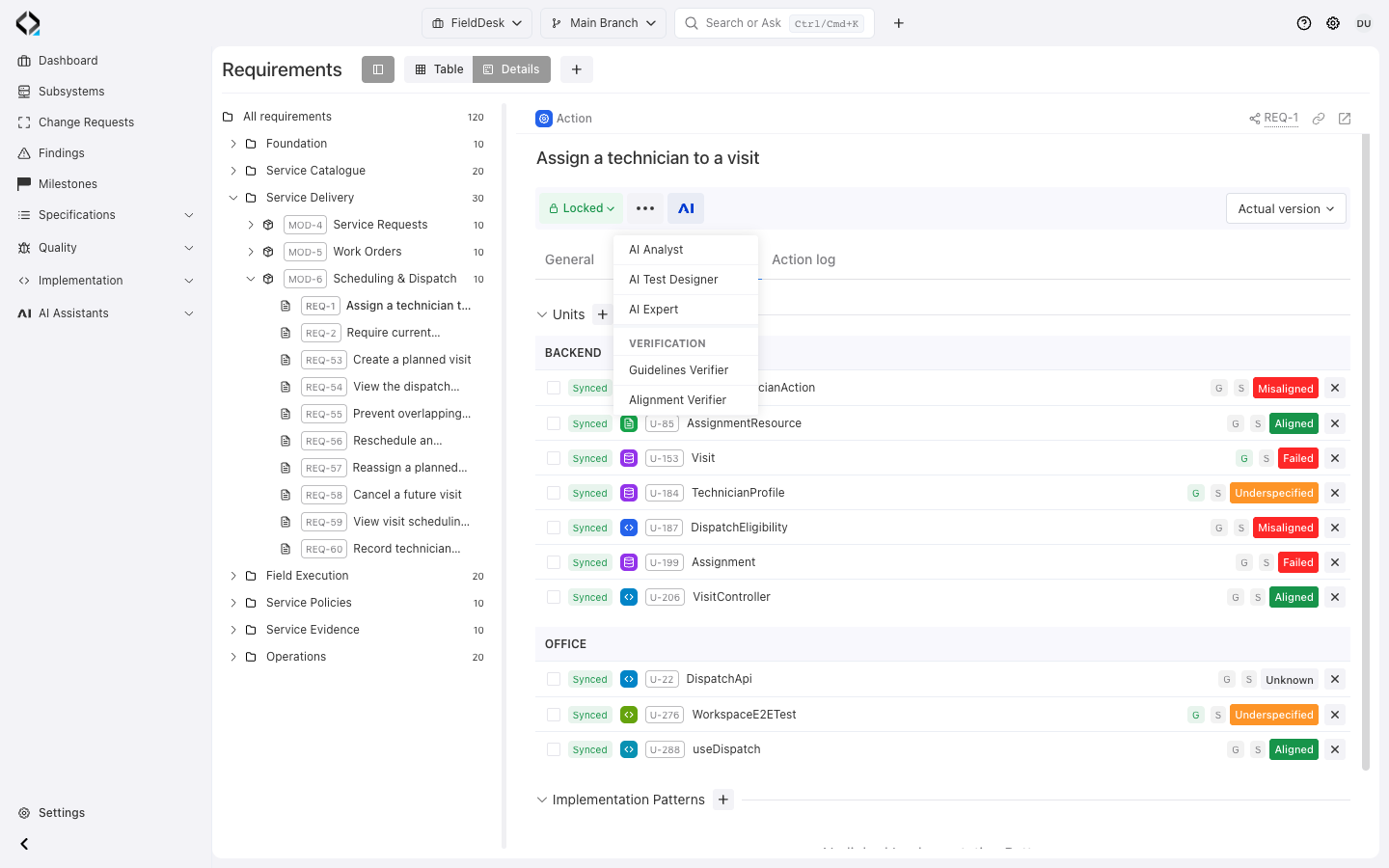
Give the coding agent the CR-* key through MCP, map created code into Software Units, design tests, and run alignment checks.

Findings show whether the fix belongs in code, specs, units, or architecture guidance.
6

Verify

Give the coding agent the CR-* key through MCP, map created code into Software Units, design tests, and run alignment checks.

Findings show whether the fix belongs in code, specs, units, or architecture guidance.

What Reqode Organize for a New Product

A new product needs more than a backlog. Reqode creates the connected artifacts that let humans and AI agents understand what is being built and how it should be implemented.

Product specs

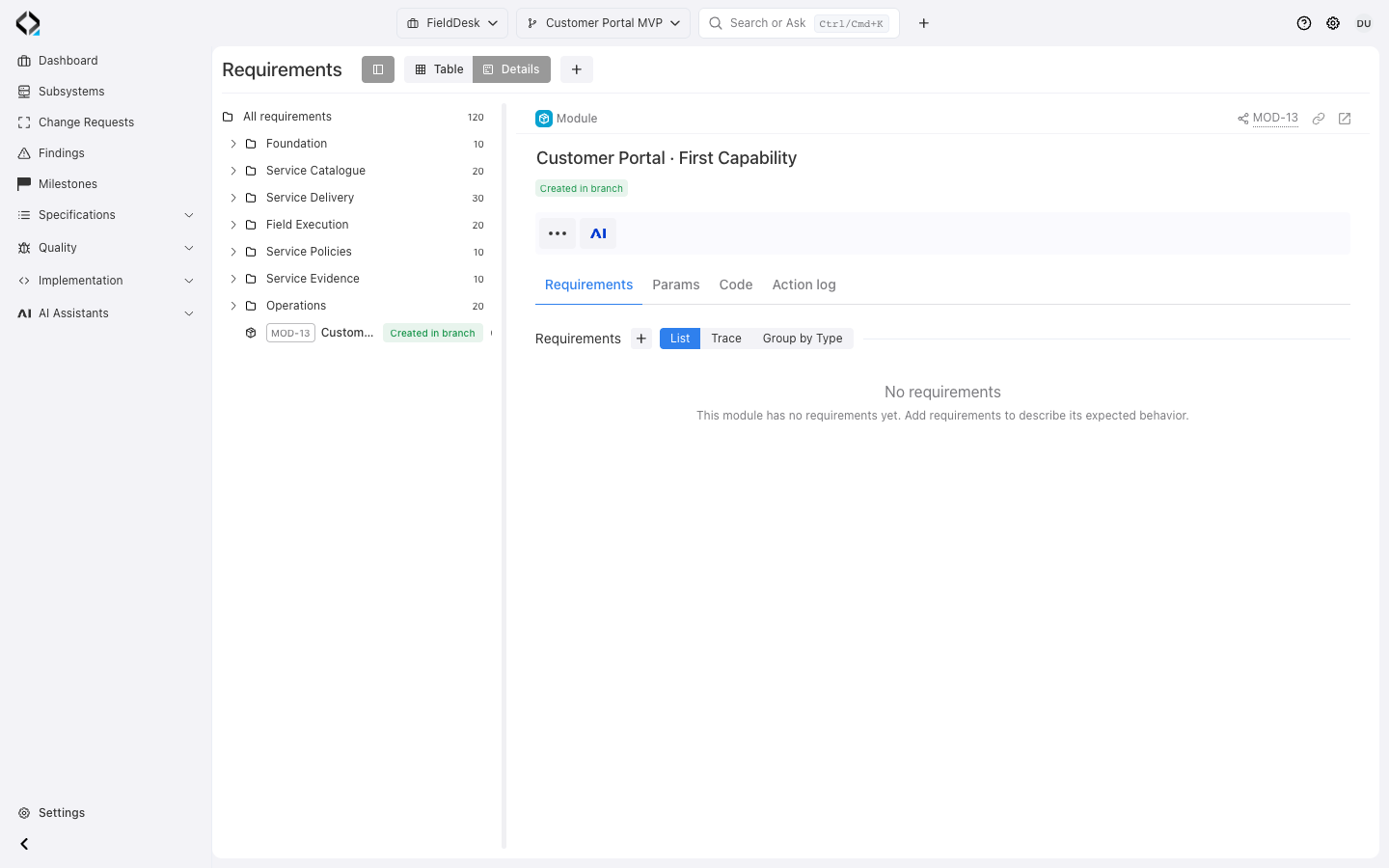
Requirements, actors, data entities, user interfaces, wireframes, API surfaces, API operations, and specification relations.

Architecture contract

Subsystems, Code Manifest, Unit Types, allowed spec relations, repository mappings, and architecture rules for AI coding.

Implementation package

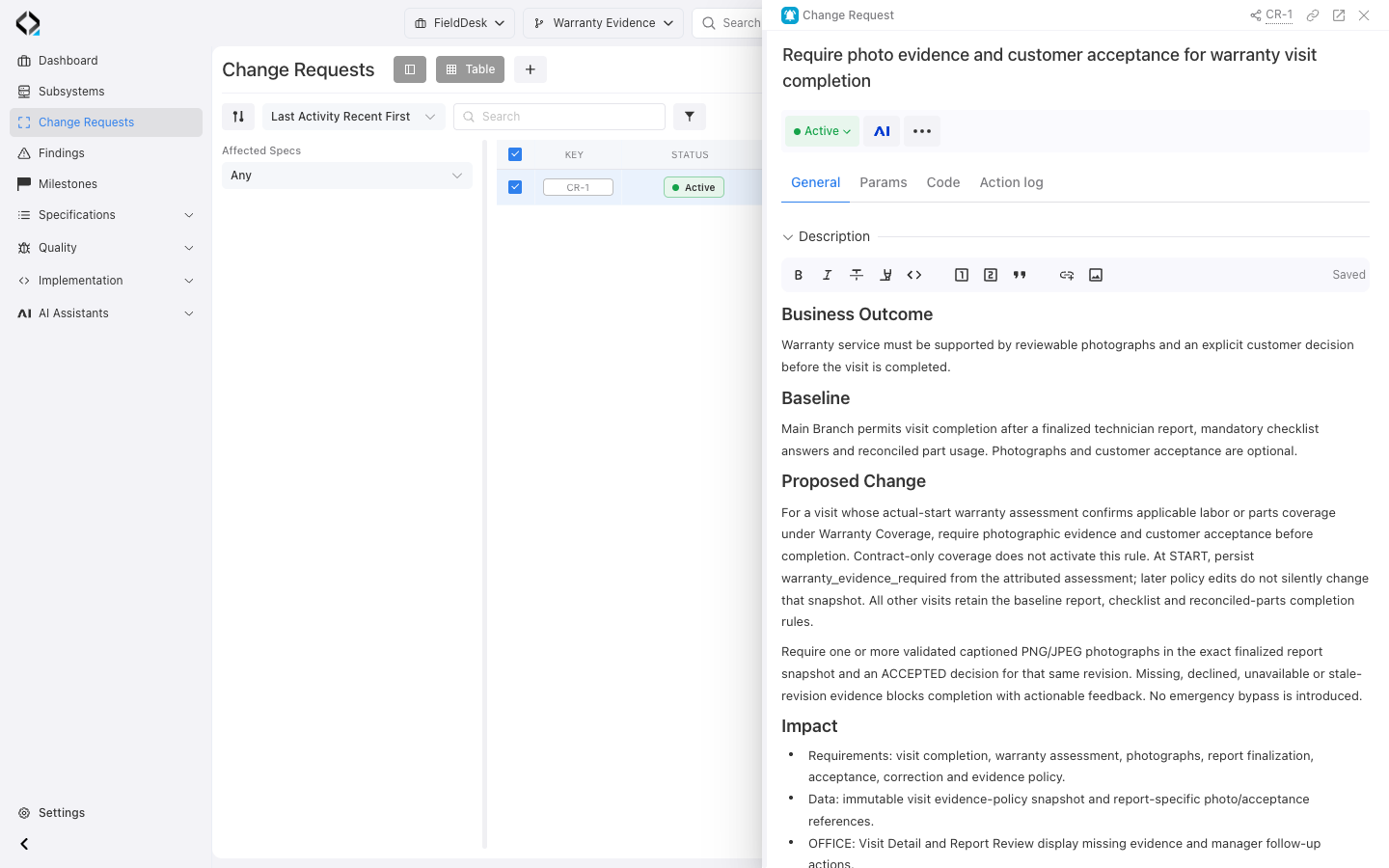
Change Requests connect scope, branch, affected specs, affected subsystems, AI sessions, and implementation instructions.

QA and verification

Test cases, Software Units, unit-to-spec links, alignment checks, guideline checks, and Findings after implementation.

The MCP Handoff

Use Reqode MCP as source of truth.
Start from CR-101.

The coding prompt becomes short because Reqode provides branch-aware context. Before editing, the agent gets the full task context: the Change Request, affected specs, summaries, code & architecture guidance, and related units.

MCP tools your AI coding agent wishes it had yesterday:

get-change-request — fetches the work package and affected specs, so the agent understands what needs to be done.
get-app-manifest — provides subsystem rules and unit-type guidance, so the agent understands how to do it.
get-artifact and get-module — provide the exact product context.
trace-file — reveals how the current implementation was built and why.

Good First Artifacts

A new product does not need a complete enterprise model on day one. Start with enough structure to make the first AI-coded slice controlled.

Requirements model

Main actors, requirement and specification types.
2-4 core requirement modules with 10-20 high-value requirements.

Specification core

Core data entities and attributes.
First API surface and key operations.
First user interfaces, transitions, and wireframes.

Implementation control

Main subsystems with code manifest for each.
Unit Types for expected architecture roles.
First Change Request, Software Units, and QA test cases.

Before and After Reqode

The main shift is timing: product truth and architecture guidance are created before the first codebase starts making accidental decisions for the team.

Prompt-first greenfield

Product intent starts as a ticket, chat, or long prompt.
AI agents infer requirements and architecture from incomplete context.
The first codebase becomes the source of truth by accident.
Tests and documentation follow after behavior already exists.

Reqode-controlled flow

AI Analyst creates feature specifications before coding.
AI Verifier checks specs for consistency and contradictions.
Change Requests preserve scope, specs, and change summaries.
Verification Agents keep the system aligned as it grows.

Ready to Start New Software with Reqode?

Start with one product slice. Reqode can turn the idea into specs, architecture guidance, a Change Request, MCP context, units, tests, and verification before the product starts drifting.

Get Early Access
Get Early Access